
ContentsStart0%
Start with an observable question
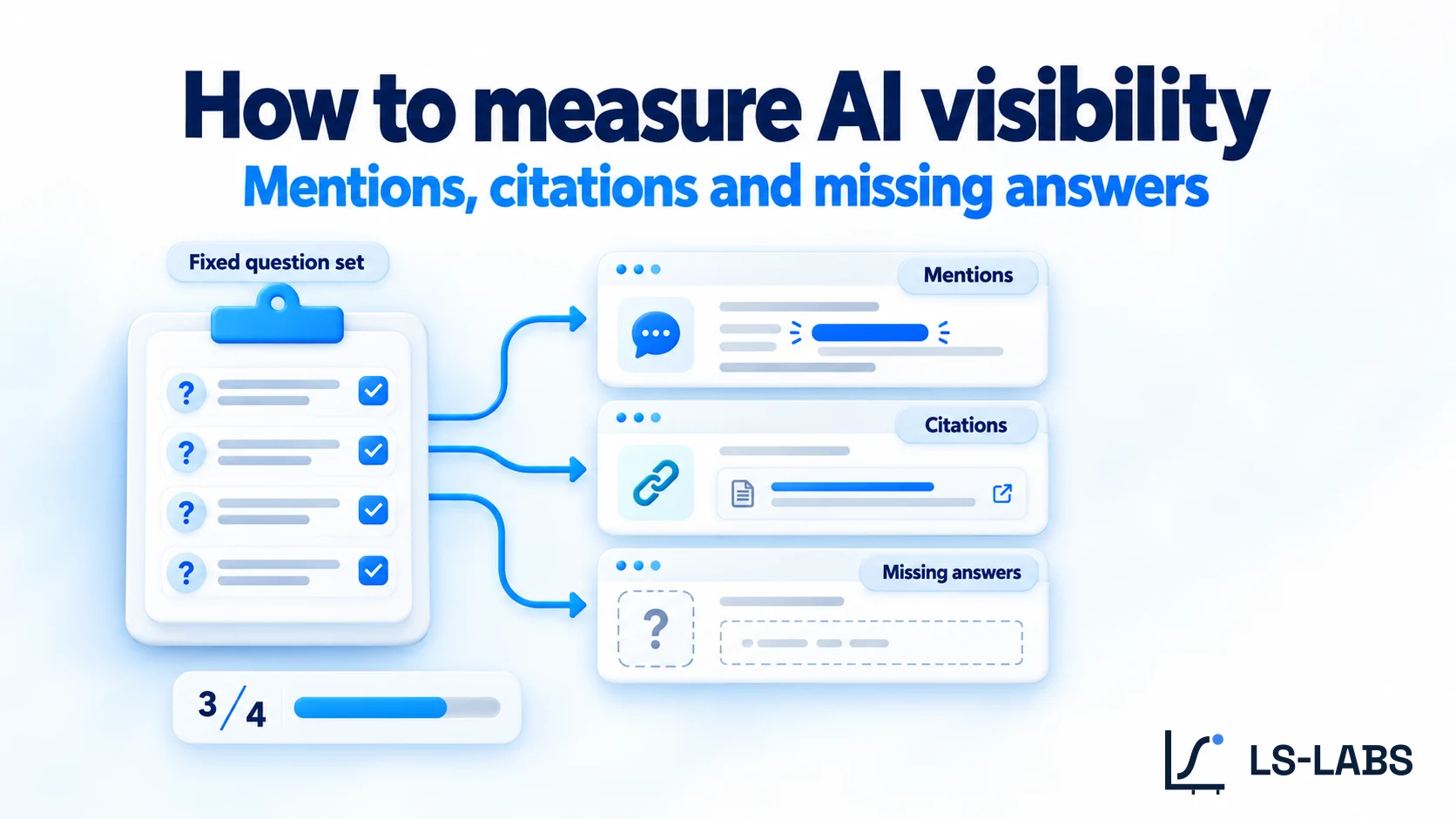
Measure AI visibility by recording a defined set of answers and stating exactly what you counted. A brand mention, an official-domain citation, an accurate address and a usable booking link answer different questions. Reporting them separately makes the result easier to interpret.
This is an editorial measurement guide adapted from LS-Labs methods and existing product documentation. It introduces no new experiment, observed rate or validated industry benchmark. The MCAC framework is one way LS-Labs organizes these observations.
Freeze the scope before collecting answers
Write down the audience, task, market, language and exact question set. Separate unbranded recommendation questions from questions that name the business or supply its URL. A question that already includes a website tests a different situation from discovering a business without that hint.
For each observation, retain the timestamp, provider and available model version, search or browsing setting, account context where known, full answer and visible source links. Record unknown environment fields as unknown. Keep retries linked to the original attempt rather than quietly counting each retry as a new independent question.
Use the same protocol when comparing periods. If the product, prompt set or sampling changes, identify the new series instead of presenting a single uninterrupted trend.
Define the numerator and denominator
| Measure | Numerator | Denominator and limit |
|---|---|---|
| Brand mention rate | Valid recommendation answers that name the specified brand under a documented matching rule. | Valid recommendation answers in the fixed sample. A mention need not be a recommendation. |
| Official-domain citation rate | Valid answers with at least one visible source link to the defined official domain. | Valid answers in the citation-eligible question set. Multiple links in one answer still count as one answer-level hit. |
| Factual agreement | Checkable claims that agree with the declared reference. | Claims actually checked, with missing references reported separately. Agreement is not an independent truth audit. |
| Action information | Eligible answers containing the specified usable action destination. | Valid action answers. This measures an entry point, not completed customer actions. |
A citation can point to a directory, review site, booking service or another publisher. Keep these sources distinct from the official domain. State whether a domain rule includes subdomains, and inspect redirects consistently. Do not infer that a page was cited merely because it appeared in a provider's retrieved-source list.
Keep failed requests visible
Here is a hypothetical reporting example: a protocol schedules 12 observations, obtains 10 valid answers and encounters two failures. Three valid answers cite the official domain. The answer-level citation rate is 3/10, and the completion count is 10/12. The two failed requests remain reported as failures; they are neither uncited answers nor evidence that the brand was absent.
That arithmetic illustrates a denominator choice, not LS-Labs campaign data. A report may also show 3/12 planned observations as a collection-level yield, but it must label that different measure rather than substitute it for the answer-level rate.
Define refusals, truncated answers, missing source lists and responses obtained without the requested search capability in advance. A response may be valid for one measure and unavailable for another.
Separate observation, explanation and business outcome
A measured change says what differed in the sample. It does not identify its cause. More mentions after a content update may also reflect a changed model, source index, query set or location. Keep the observed result separate from competing explanations and the test needed to distinguish them.
Search Console clicks and GA4 sessions add a different layer: visits that the services can observe. They do not reveal every AI answer or every citation. AI referral reporting in GA4 and SEO Pulse support traffic analysis, while answer observations address visibility.
Useful tool reporting exposes the source answer, question, denominator and failed observations. A single score without those details is difficult to audit. The LS-Labs GeoCheck explanation describes a limited four-question diagnostic rather than a market-wide measurement service.
Publish a method that someone else can inspect
Place the dates, sample, language, question types, inclusion rules and known failures beside the result. Preserve source links and the evidence allowed to be shared. Report both null and positive findings, and distinguish no detected difference from evidence that no difference exists.
The AI search retrieval report provides the research context for these distinctions. Its historical samples and Traditional Chinese setting should travel with any English adaptation. Translating the report does not create an additional independent study.